
FIDE Candidates Tournament 2026
100,000 Simulations, One World Championship Challenger
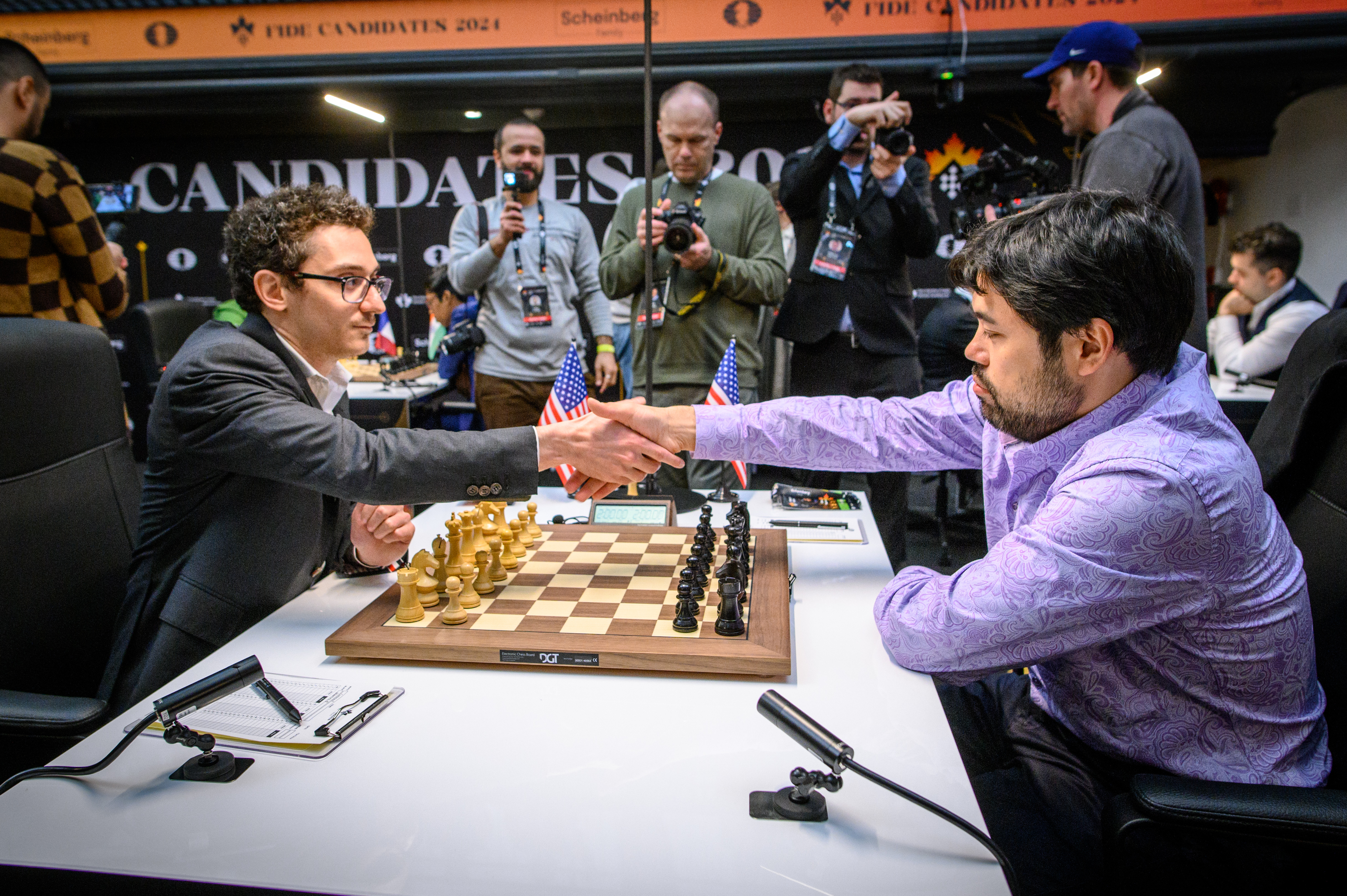 photo: Michal Walusza, FIDE
Update: The tournament is over. Javokhir Sindarov won with an extraordinary 9.5/14 performance. Read the Round 5 update for how his historic run unfolded.
The Race to Challenge Gukesh
Eight players descend on Cyprus for the most prestigious qualifying event in chess: the FIDE Candidates Tournament. The prize? The right to challenge Gukesh Dommaraju, the youngest undisputed World Chess Champion in history, for his crown. I’ve simulated the tournament 100,000 times using players’ current Elo ratings and my machine learning game prediction model to see who has the best shot.
The field is headlined by two familiar names. Hikaru Nakamura (2810) and Fabiano Caruana (2795) tower over the rest of the field. Behind them, a tightly packed middle tier: Giri, Praggnanandhaa, and Wei Yi are separated by just 6 Elo points. Then there’s a significant drop to the three underdogs: Sindarov, Esipenko, and Bluebaum.
Let’s dig in.
What 100,000 Simulations Say
Nakamura enters as the clear favorite at 32.0%, followed by Caruana at 25.8%. Together, the “Big Two” account for nearly 58% of all simulated wins. Behind them, there’s a four-player scrum between Giri (12.8%), Praggnanandhaa (12.2%), and Wei Yi (11.1%) – any one of them could realistically win.
Then comes the cliff. Sindarov has a puncher’s chance at 4.2%, but Esipenko (1.2%) and Bluebaum (0.8%) would need a minor miracle. Read about my prediction methodology if you’re curious about how this works.
Know Your Enemy: Head-to-Head
Here’s where it gets interesting. The heatmap below shows the expected score for every possible matchup, from White’s perspective. Green means White is expected to do well; red means Black has the advantage. Hover over any cell to see the exact win, draw, and loss probabilities.
Some things jump out immediately:
- Caruana vs. Nakamura is the closest matchup among the top players at 0.52 – essentially a coin flip with a slight white advantage. That’s exactly why their games show up as the most tournament-altering matchups later in this analysis.
- The middle pack is a knife fight. Giri, Praggnanandhaa, and Wei Yi all score between 0.53 and 0.56 against each other. When the average winning score is just 9.3 out of 14, a single decisive game between any of them could be the difference between a World Championship match and going home.
- Praggnanandhaa vs. Nakamura looks competitive here (0.53 expected score for Nakamura with white), but keep reading – that parity evaporates in speed chess, where Pragg’s chances drop by 3 full percentage points if the tournament goes to tiebreaks.
Speed Kills: The Tiebreak Factor
Tiebreaks happen in 20.6% of simulations – that’s about 1 in 5 tournaments. When they do, the results shift dramatically. The dumbbell chart below shows each player’s win probability in classical-only finishes versus tiebreak finishes.
The biggest winners from tiebreaks? Nakamura (+2.0 points), Sindarov (+2.0), and Wei Yi (+1.7). This makes sense: Nakamura’s blitz rating of 2838 is absolutely terrifying in rapid/blitz playoffs. Sindarov’s rapid rating (2727) is actually higher than his classical rating, making him a tiebreak specialist.
The losers? Praggnanandhaa (-3.0) and Giri (-2.3) see their chances drop significantly when tiebreaks happen. Pragg’s rapid rating of 2663 is a full 95 points below his classical – a massive liability if the tournament goes to speed chess.
The takeaway: if you’re rooting for Pragg or Giri, you want the tournament decided in classical games.
How Many Points Does It Take?
The double round-robin format means each player plays 14 games. So what score does the winner typically need? Across 100,000 simulations, here’s the distribution of winning scores.
The average winning score is 9.3 points (out of 14), with the median at 9.0. The sweet spot is 9.0-9.5 points, which accounts for over half of all wins. You can win with just 8.0 points (it happens in 5.2% of simulations), but you’ll almost certainly need tiebreaks to pull it off. On the rare occasion that someone scores 10.5+, they’ve typically run away with the tournament.
But not all 9-point finishes are created equal. The chart below flips the question: if a specific player scores X points, how often do they win the tournament?
At 9.0 points, Nakamura wins the tournament 63% of the time – compared to Caruana’s 59% and Giri’s 50%. That gap is Nakamura’s tiebreak advantage at work: when multiple players finish on the same score, his 2838 blitz rating makes him the favorite in speed playoffs. Even at 8.5, Nakamura converts at 34% while Caruana sits at 29% and the middle of the pack hovers around 22-27%.
The convergence at 10+ points is striking. Score 10 or more and every player – even Bluebaum – wins over 90% of the time. At those heights, you’ve simply outpaced the field and tiebreaks rarely matter.
The Games That Decide Everything
Not all games are created equal. Some individual matchups swing the entire tournament. The chart below shows the 10 most impactful games – the ones where the result most dramatically shifts a player’s winning chances.
The most impactful single game in the tournament? Caruana vs. Nakamura (Caruana with white). If Caruana wins that game, Nakamura’s chances drop from 32% to just 18%. If Nakamura wins with black, his chances soar to 49%. That’s a 31 percentage-point swing on a single game.
Notice how Nakamura dominates this list – 8 of the top 10 most impactful games involve him. That’s what happens when you’re the favorite: every result either confirms or derails the expected outcome. If you can only watch a few games, circle the Nakamura-Caruana clashes on your calendar.
The Bluebaum Factor
Every Candidates Tournament has a player who enters as the lowest seed. In 2026, that’s Matthias Bluebaum at 2684 – a full 126 Elo points below Nakamura. His 0.75% win probability makes him a massive long shot, but his impact on the tournament extends far beyond his own chances.
The charts below show each player’s tournament winning probability conditional on their result against Bluebaum. Beat him, and your chances jump. Lose to him, and you’re in trouble.
Nakamura’s tournament chances swing from 39% (if he beats Bluebaum with white) down to 17% (if he loses) – a 22-point swing on a single game against the lowest-rated player. Caruana sees a similar pattern: 32% if he wins, 12% if he loses. The Bluebaum games aren’t just free points to collect; dropping one is genuinely devastating.
The middle pack feels this even more sharply in relative terms. Wei Yi’s chances nearly triple from 5% to 15% depending on his white game against Bluebaum. For Giri and Pragg, a win roughly doubles their odds compared to a draw.
Don’t count Bluebaum out entirely, either. He wins 0.75% of simulations – a long shot, but not zero. And if he can steal a few critical half-points from the favorites, he becomes the ultimate kingmaker.
What To Watch For
Here’s your cheat sheet for following the 2026 Candidates:
- The Nak-Fabi rivalry: These two games are the most important in the entire tournament. The results will likely determine the winner.
- Tiebreak insurance: Watch Pragg and Giri closely. If they’re tied for first, they need to win outright – tiebreaks are their kryptonite.
- Bluebaum’s results matter for everyone: Not just for him, but for the favorites counting on those points. An upset from Bluebaum against a top player could blow the tournament wide open.
- 9 points is the magic number: The average winning score is 9.3/14 – anyone on pace for that by the halfway mark is in great shape.
After every round, check out my simulations page for updated predictions. You can filter simulations by game outcomes to get instant updated odds. Happy watching!